25
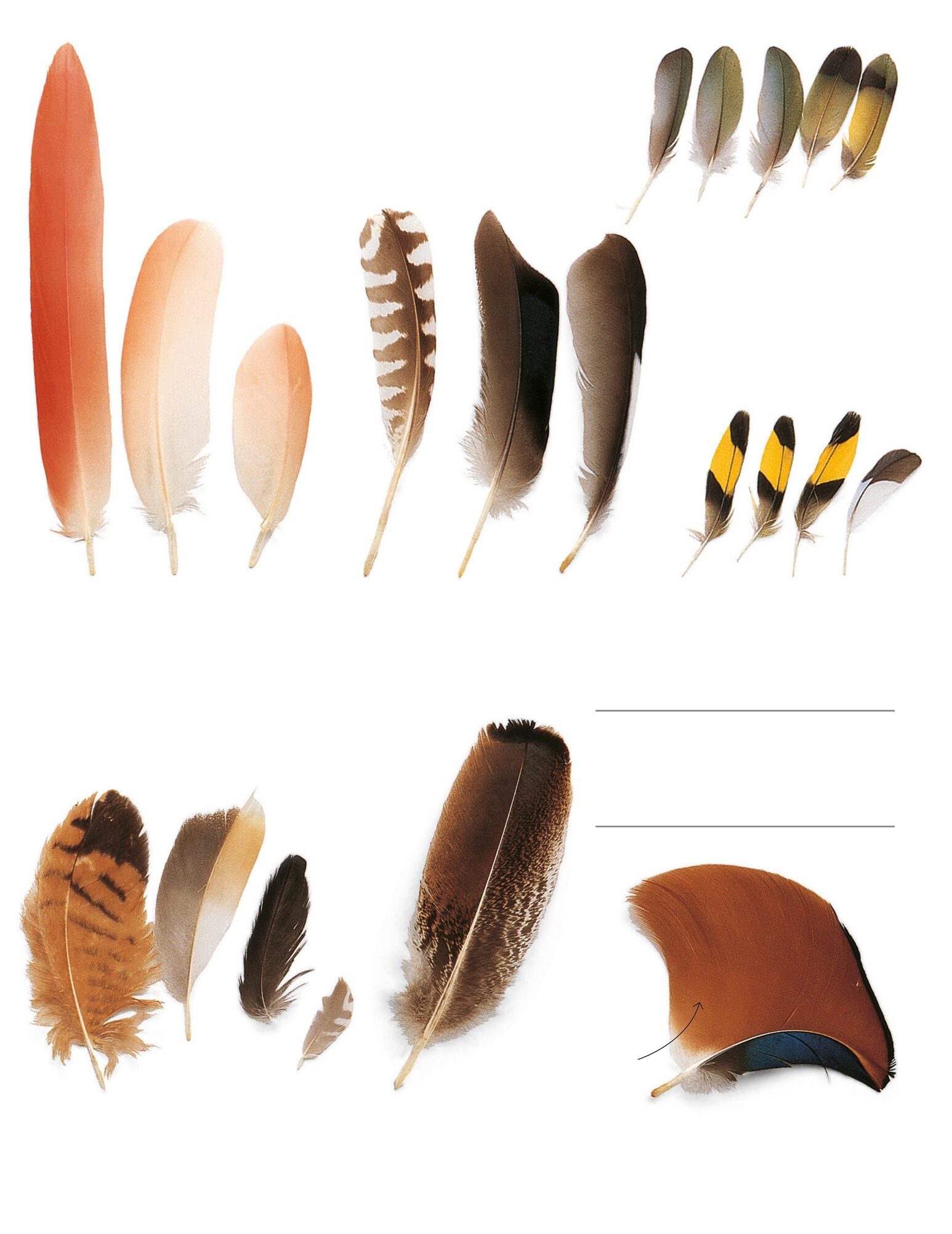
The inner wing
Inner wing feathers are generally shorter than
those on the outer wing. As they are not subject
to as much force during flight, their quills are
shorter and their feathers are less well anchored.
Feather from
junction of
wing and body
A balanced blade
The feathers between the
inner and outer wing have
curved quills and blunt tips.
Inner wing feathers point
away from the wind, so they
do not need a lopsided shape
to provide lift.
In-flight markings
The bright colours of many
birds are revealed only when
their wings are fully open.
Sail feathers
The male mandarin duck
uses its sail feathers to
attract a mate.
Infrequent fliers
The wild turkey lives on
the ground and rarely
uses its feathers for flight.
Curlew
Eagle owl
Underwing feathers
The underwing coverts lie
close together to smooth
the flow of air.
Rook
Bustard
Coloured by its food
The greater flamingo eats shrimp,
which have in turn eaten algae
containing pigments called
carotenoids. It is these pigments
that give the flamingo’s feathers
their pink colour.
Secondary feathers
Secondary feathers are broader than
primary feathers and cannot be controlled
as much. These help the bird to lift and
stay in the air.
Jay
Mallard
Curlew
Inner flight
feathers
Feathers
make up about
5 to 10 per cent
of
a
bird’s weight
.
Sail feather
attached to
base of wing
Wild
turkey